

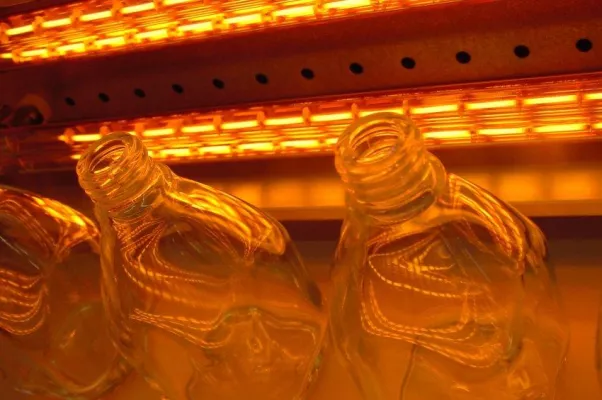
On the glass line, wasted energy and uneven heat don’t show up as theory—they show up as scrap, rework, and downtime. If you can’t trust the thermal profile on every tempering cycle, every bending station, and every lamination press, you’re going to pay for it: thermal stress cracks, optical distortion, and edge compression that falls short. Sustainable glass manufacturing isn’t a slogan. It’s discipline—built on repeatable heat control. What matters, technically We put the heat into glass processing with engineered radiant elements—quartz or short-wave halogen emitters chosen for fast response and tight temperature repeatability. The whole point is a stable thermal field across the glass surface, so you don’t get hot spots or convection swings that push warp and stress. Emissivity and reflector geometry are matched to the glass coating and substrate, so the energy goes into the glass, not the frame. Power density is sized to line speed, so the furnace or oven recovers quickly after door cycles and holds setpoint without overshoot. Why this lands in real operations In tempering, uniform heating cuts edge failures and keeps surface compression in spec, so first-pass yield climbs. In bending, controlled heat distribution gives you consistent sag, which means less trim and polish. In lamination, a predictable ramp-up shortens press time without hurting adhesion, which drops kWh per part. The upshot is fewer rejects, faster changeovers, and a smaller carbon footprint per square meter shipped. The practical details you can’t skip These modules drop in as direct replacements for many OEM furnace banks, but you still have to confirm mounting, insulation, and the control interface against your machine’s tolerances. Plan clearances carefully—otherwise you’ll cook nearby fixtures and create hot spots. And before you switch over, double-check voltage and phase compatibility. With the setup done right, the system can run 5,000+ hours with minimal output drift, but it will follow the basics: keep reflectors clean and keep mains voltage stable.